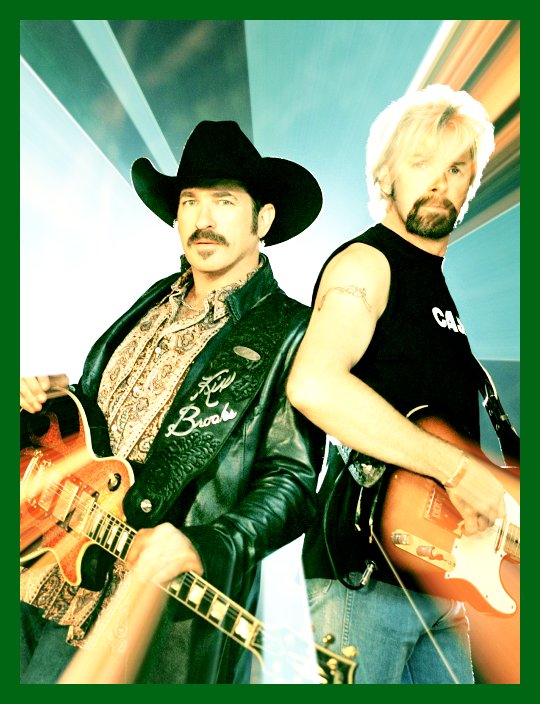
The undisputed kings of the '90s line-dancing craze, Brooks & Dunn
are not only the biggest-selling duo in country music history, they've
also sold more records than any other duo period, save for Simon & Garfunkel. Ronnie Dunn was the quietly intense singer with the soulful voice, while Kix Brooks played the part of the high-energy showman. Neither had been able to
break through as a solo act, but together they hit upon a winning
formula of rambunctious, rocked-up honky tonk with punchy, danceable
beats, and alternated those cuts with smooth, pop-tinged ballads. The
combination made them one of the most popular country artists of the
'90s, and they were still going strong as the new millennium dawned.
Leon Eric "Kix" Brooks (born in Shreveport, LA) and Ronnie Gene Dunn
(born in Coleman, TX) arrived in Nashville from very different
backgrounds. Brooks was a neighbor of Johnny Horton
and first began singing with the country legend's daughter at age 12;
after a time working on the Alaskan oil pipeline, he moved to Maine and
performed in ski resorts and other local venues. He went to Nashville
in the early '80s and found success as a songwriter, penning hits for John Conlee, Highway 101, and The Nitty Gritty Dirt Band,
among others; however, his solo recordings -- a few small-label singles
in 1983 and a self-titled album in 1989 -- failed to make any impact. Dunn,
meanwhile, had been playing with traditional string bands since he was
a teenager, but originally aspired to become a Baptist minister. He
attended the highly conservative Abilene Christian University, but was
kicked out for continuing to play music on the side in area bars. He
decided to pursue music full-time and moved to Tulsa, where he led a
house band and recorded for a local label from 1983-1984. In 1988, he
won a songwriting contest whose prize included a recording session in
Nashville; the producer, Scott Hendricks, was impressed enough to pass some of Dunn's material on to Arista executive Tim DuBois. He had a hunch that Dunn and Brooks
would complement each other well, and he introduced the two and
encouraged them to try writing and recording some demo songs together.
When he heard the results, DuBois signed the newly minted Brooks & Dunn duo to a contract.
Brooks & Dunn issued their debut album, Brand New Man,
in 1991, and it was an out-of-the-box smash. The title track, "My Next
Broken Heart," "Neon Moon," and "Boot Scootin' Boogie" all hit number
one on the country charts, and the latter song in particular was an
inescapable smash that helped kick-start the line-dancing fad that
swept country bars across the nation. Brand New Man
eventually went on to sell over five million copies, and made the duo
into country superstars; their supporting tour established their
penchant for theatrical live shows as well. Their follow-up, Hard Workin' Man,
consolidated their success with a string of five Top Five country hits:
the title track, the number ones "She Used to Be Mine" and "That Ain't
No Way to Go," and the number twos "We'll Burn That Bridge" and "Rock
My World (Little Country Girl)." Hard Workin' Man
sold over four million copies, and by the time its run of singles was
exhausted, the duo had already completed a follow-up in 1994's Waitin' On Sundown.
Five more Top Ten hits followed, including the number ones "She's Not
the Cheatin' Kind," "Little Miss Honky Tonk," and "You're Gonna Miss Me
When I'm Gone" (the others were "I'll Never Forgive My Heart" and
"Whiskey Under the Bridge"). Waitin' On Sundown went double platinum, confirming Brooks & Dunn's status as a blockbuster success.
But this was not the end of their success. They continued to produce No.1 albums with more No.1 hits, winning Vocal Duo of the year 14 times during their whole career. They were also the first duo to win in country music history to win the pretigeous honor for Entertainer of The Year.
In 2009, they announced their break-up.
Source: www.allmusic.com